https://ift.tt/30WVedQ<br>
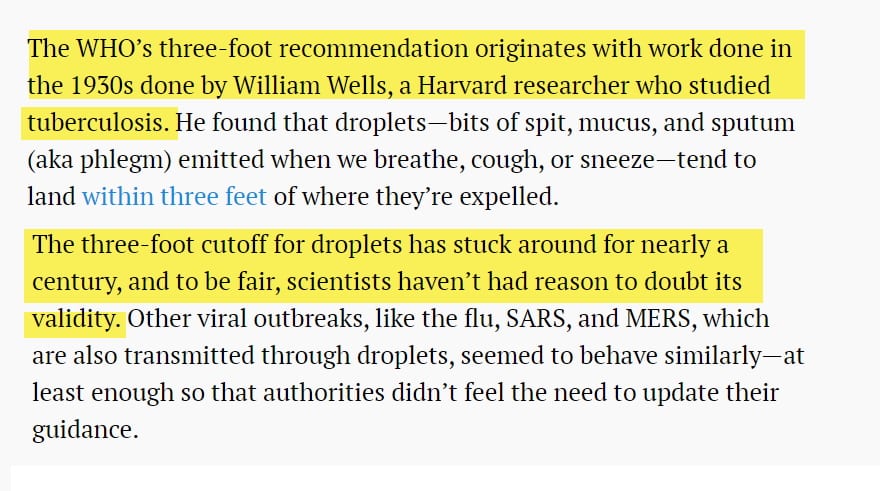
<p>William Firth Wells, with his research from the thirties, provided
the basis for social distancing<a
href="https://qz.com/1831100/where-does-the-six-feet-social-distancing-guideline-come-from/">,
to keep the distance of more than 3 feet.</a></p>
<p><a href="https://www.maurice.nl/2020/06/18/game-set-het-zijn-de-aerosols/wells-in-quarts/"
rel="attachment wp-att-7259"><img class="aligncenter wp-image-7259"
src="https://www.maurice.nl/wp-content/uploads/2020/06/Wells-in-quarts.jpg"
alt="" width="686" height="383" /></a></p>
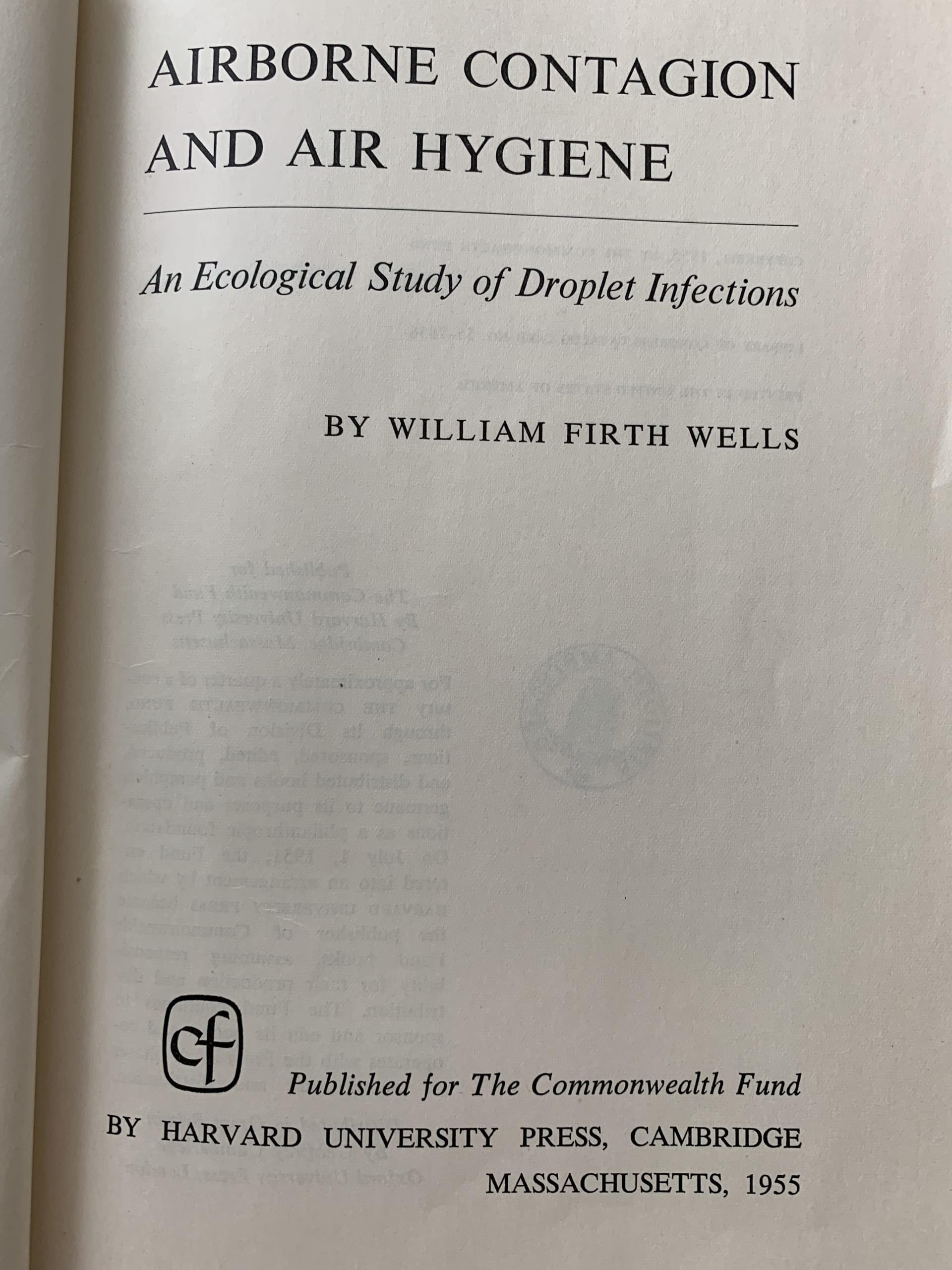
<p>I was curious and tried to find his 1955 masterpiece:
“Airborne contagion and Air Hygiene”, with a description
of all his scientific work.</p>
<p>It took a lot of effort to find that 1955 book, but now I have it
and it’s more than worth it.</p>
<p><a href="https://www.maurice.nl/2020/06/18/game-set-het-zijn-de-aerosols/wells/"
rel="attachment wp-att-7252"><img class="aligncenter wp-image-7252"
src="https://www.maurice.nl/wp-content/uploads/2020/06/Wells-scaled.jpg"
alt="" width="822" height="1096" /></a></p>
<p>It’s about the research Wells has done since 1930 on the
contagiousness of all kinds of diseases, with reports of many
experiments. It’s a kind of handbook, and rightly so. It’s
amazing what that man has done in those 25 years. If he’d still
been alive, the world would have been a much better place and hundreds
of thousands less people would have died.</p>
<p>When I looked in Wells’ book for that “empirical rule
of thumb” of keeping your distance, I was astonished. It was
just research into how far larger droplets spread when they come out
of a person’s mouth or nose. And yes, most of them end up on the
ground within 3 feet.</p>
<p>But in no way was it determined whether someone was infected when
they got in contact with those drops from a short distance.</p>
<p>It was something like measuring how far the best golfer can hit the
ball. That’s over 400 meters. But that doesn’t mean the
ball will end up in the hole. You have to determine that separately.
And Wells didn’t do that.</p>
<p> </p>
<p>But that wasn’t the reason for my astonishment. From the
title of his book it is clear, what the subject of this 400-page
collection is: “Airborne contagion and Air Hygiene”. This
is also explicitly stated in the subject description (page 319):</p>
<p style="padding-left:40px;">“Droplet infections are primarily
airborne; airborne epidemics are absent from an ecological population
provided with adequate air hygiene”.</p>
<p>And the whole book is about that. Applicable to a whole series of
infectious diseases, especially through bacteria/parasites, but also
through viruses. A large number of experiments are reported on. How
the infection takes place and what measures can be taken in the indoor
environment to prevent it. Really impressive.</p>
<p>But I fell off my chair when it came to the animal experiments with
the tuberculosis bacterium and the influenza vaccine. In both trials
there were results that Wells himself says: “truly
astonishing” (page 119). There was a big difference between the
animals that were “offered” the big drops and the animals
that were “offered” the micro drops.</p>
<p>The difference was a factor of 16 times. 32 of the 33 animals that
inhaled the aerosols got a lung infection. None of the animals that
were offered the large drops showed a form of swallowed infection
after 6 weeks.</p>
<p>In short: larger drops do not cause an infection with tuberculosis,
only through airborne microdroplets, which are inhaled by the animal
(person) for a while and then “nestle” in the lungs.</p>
<p>But yes, one will object, tuberculosis is a bacterium.</p>
<p>But then on page 119 we see the following about experiments with
mice: “<strong>Influenza virus inhaled in large and small drops
DUPLICATED the effect observed in experiments with
tuberculosis”. Mice that inhaled the aerosols died quickly.
While the mice that had come into contact with the large droplets were
much better off.</strong></p>
<p>It then goes on to say that the influenza virus inhaled in
microdroplets was much more contagious than if those drops had been
removed from the air and inserted into the nose. The rest of the
chapter describes tests with other infectious diseases, such as group
C Streptococci. And the results are always the same.</p>
<p>The small particles can penetrate directly into the lungs and do,
if they are in sufficient numbers, very their destructive work there.
Larger particles/droplets do not succeed that -or to a much lesser
extent- Wells states. They are retained in the upper respiratory tract
and do not lead to contamination, or only to a much lesser extent.</p>
<p>It is astonishing that the much vaunted handbook of 1955 already
explains very explicitly that the aerosols are the major distributor
of almost all diseases that have been studied. They go directly to the
lungs and do their destructive work.</p>
<p>The large drops, if they hit you at all, enter the upper
respiratory tract and are very difficult to reach the lungs. But WHO,
and therefore all CDC’s in the world, don’t adhere to what
Wells has been experimenting with since 1955. The danger does not come
from the larger drops.</p>
<p>We have to protect ourselves from breathing in the aerosols too
long. And we can abolish social distancing, keeping whatever meters,
worldwide.</p>
<p>Fresh air and higher humidity are the protection against the
aerosols staying airborne in enclosed spaces for a long time.</p>
<p>Outside, the aerosols don’t get stuck around you and you are
completely safe.</p>
<p>Do you understand why there were such l<a
href="https://www.maurice.nl/2020/05/01/meat-processing-industry-superspreading-hot-spots/">arge
outbreaks in slaughterhouses</a> all over the world (little
ventilation and low temperatures, the ideal circumstance for the virus
to float)?</p>
<p>But do you now also understand why WHO and the CDC’s
don’t mention it as such, because if they acknowledged it, their
whole position on social distancing would be undermined.</p>
<p>And what happened in Beijing lately also confirms that pattern. (In
a wholesale center near the meat and fish department, where it is also
much colder than elsewhere).</p>
<p>Outbreaks in hot areas also seem to be related <a
href="https://www.maurice.nl/2020/06/18/the-risks-of-air-conditioning/">to
the use of air conditioners</a></p>
<p> </p>
<p>As long as WHO and CDC's do not maximize their efforts to prevent
the floating viruses, but do want to keep the "one and a half meter
society" afloat, hundreds of thousands of people worldwide will die
needlessly (if not more) and the economy and society will be held in a
stranglehold of their "new normal".</p>
<p>I hope that politicians, media and citizens now realize that the
CDC's and the usual suspects in the media, are wrong and have led to
the wrong policy with enormous social and economic consequences. On
the basis of this information from Wells and what <a
href="https://www.maurice.nl/2020/06/05/the-big-impact-of-superspreading-events/">we
now know about superspreading events</a>, it is easy to implement a
simple policy in which the risks of infection can be kept well under
control (also in the autumn) and the economic and social consequences
can be greatly reduced.</p>
<p> </p>
<p> </p>
<p>Het bericht <a rel="nofollow"
href="https://www.maurice.nl/2020/06/21/wells-showed-it-in-1955-its-the-airborne-microdroplets/">Wells
showed it in 1955; it’s the airborne microdroplets</a> verscheen
eerst op <a rel="nofollow" href="https://www.maurice.nl">Maurice de
Hond</a>.</p>
<br>
<br>
Maurice de Hond<br>
https://ift.tt/30WVedQ<br>

Geen opmerkingen:
Een reactie posten